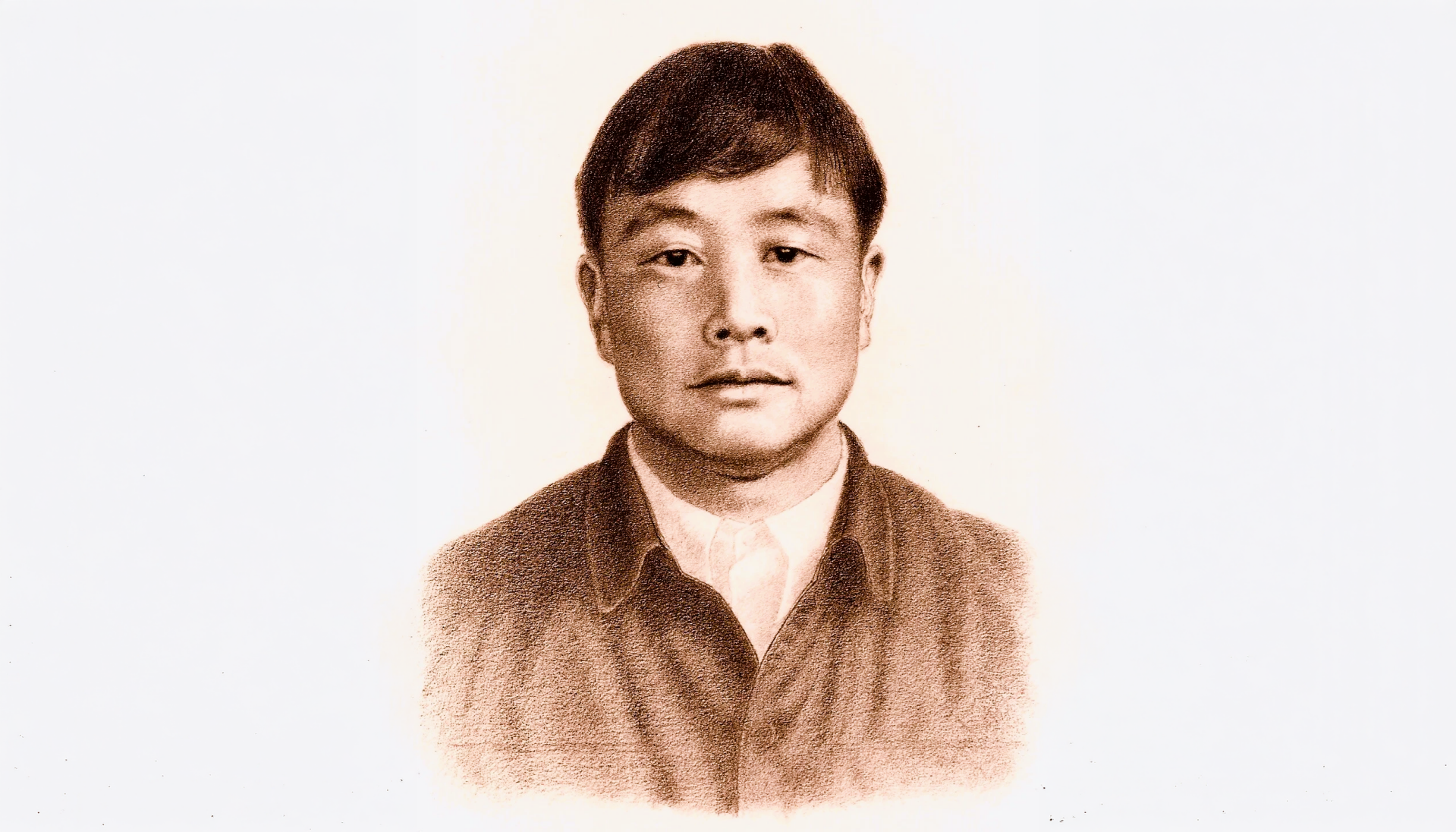
Medium: Graphite | Year: 1998
Some portraits begin with a sitting. This one began with a photograph the size of my thumbnail, cracked, faded, and the only proof that a man named Jay Sr. had ever walked through the world.
I made this piece for Father's Day, but really, I made it for my friend Jay Jr., and for the father he lost long before I ever knew him.
A Friendship Built on Favors
Jay Sr. died of throat cancer in China at forty-two. His son, Jay Jr., was fourteen at the time, still in school, still learning how to teach his own father to read and write. When his father died, that ended. Jay Jr. left school and went to work in a factory to help support what was left of his family.
Fifteen years later, our paths crossed in New York City. I was the superintendent of a building; Jay Jr. ran a general merchandise store in the same one. By then he was married with three daughters. "I love my daughters so very much," he told me once, and I believed him completely, he said it the way people say things they've earned the right to say.
Jay Jr. was the kind of neighbor every building needs. He knew electricity and plumbing better than I ever would, and whenever something in the building broke beyond my own skill, he was already there fixing it before I'd finished asking. I owed him more favors than I could ever repay in kind.
One day he handed me something instead of a tool: a small, cracked photograph, barely an inch square. "This is a picture of my father," he said. "It's the only record we have of what he looked like." I looked at that fragment for a long moment and offered to turn it into a portrait he could actually hang on a wall.
Symbolic Elements and Visual Design
The central symbol of this piece is the act of enlargement itself, taking something reduced almost to nothing and giving it back its full size. A father's entire life had been compressed into a single cracked square of paper; the portrait was my attempt to let him take up space again, to exist at the scale a person deserves.
There's a dichotomy running through the whole composition: fragmentation and wholeness. The source photograph was broken, dark, and incomplete, details lost to time, damage, and a lens that was never meant to preserve a face for thirty years. The finished portrait had to hold both truths at once: it is faithful to what remained, and it is also, unavoidably, an act of imagination filling in what the crack had erased. Every portrait like these lives on that line between record and reconstruction, between what we know and what we choose to believe was true.
And then there's the coincidence I still think about, that the three of us, father, son, and artist, all carried the same name. Jay. A quiet thread of unity running through a story that is otherwise about separation: a father taken too early, a son who left school too soon, and a photograph too damaged to fully trust.
Techniques
Working from a photograph this small and this degraded meant the technical process was really a process of translation, one stage at a time.
I first enlarged the damaged photocopy on a photocopy machine, pushing it up in size until I had something I could actually study instead of squint at. From that enlargement, I traced the outline in ink onto acetate, then used a lightbox to transfer that outline onto Bristol board, the same method a lot of portrait and comic artists use to move a reference accurately from one surface to another without losing proportion.
Only after the outline was secure did the real work begin: building the drawing in graphite, layer by layer, observing everything the photograph still offered and imagining what it had lost. Where the damage had eaten away detail, the exact fall of light across a cheekbone, the precise set of an eye, I had to draw not just what I saw, but what I believed a man like Jay Sr. would have looked like, based on everything his son had told me about him.
Emotional Impact
I don't think I fully understood the weight of the piece until Jay Jr. stood in front of the finished drawing. "Wow!" he said. "This really does look like my father!" There was real astonishment in his voice, not polite appreciation, but genuine recognition, as if a memory he'd been carrying in fragments had suddenly resolved into a whole picture.
That moment is, for me, the entire purpose of portraiture like this. A photograph can prove someone existed. A portrait, when it works, can give the people left behind a place to look their loss in the eye again, something closer to the felt memory than the damaged evidence ever could be.
A Lesson From the Portrait
A one-inch photograph is not much to build a father's memory on. But it was enough, because what filled in the rest wasn't just craft, it was everything Jay Jr. carried with him: fifteen years of missing someone, a factory floor he went to instead of a classroom, three daughters he loved fiercely partly because of what he'd lost too young.
That's the lesson this piece keeps teaching me. We rarely inherit whole pictures of the people who shaped us, we inherit fragments: a cracked photo, a half-remembered story, a skill passed down without explanation. What we do with those fragments, how faithfully and how lovingly we try to complete them, is its own form of love. Complexity, dichotomy, unity, a father reduced to almost nothing, and a son who refused to let him stay that small.
"Every time I describe a photograph, I am writing a fiction." — Teju Cole
It's a line about photography, but I think it holds just as true for portraiture drawn from a broken one. What I gave Jay Jr. wasn't a copy of his father. It was my best, most careful act of faith in what remained.
Add comment
Comments
Incredible you continue to show how talented you are.