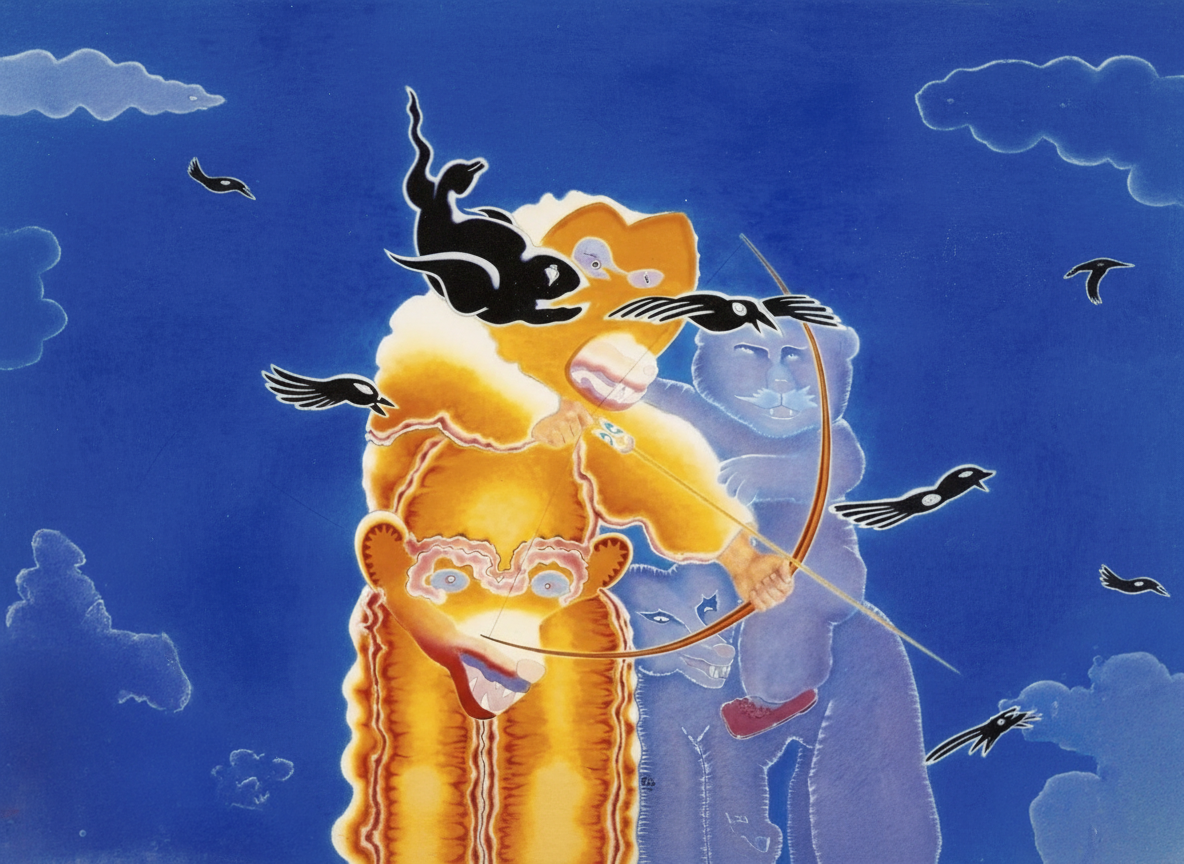
Medium: 4 x 6 Acrylic
Date: 1981
Some paintings arrive as quiet observations; others insist on becoming fully realized. “The Difficulty in Taking Aim” belongs to the latter. This four-by-six-foot acrylic painting emerged from a smaller watercolor study that continued to live vividly in my imagination long after it was completed. I felt compelled to return to it, to expand its symbolic language, and to give its inner energy a larger, more immersive form.
At the center of this work are two shamans. One draws the bow and attempts to take aim, while the other stands beside him, offering guidance and support. What interested me was not merely the act of aiming, but the challenge within it—the effort to align intention, perception, and action. In that moment of concentration, the presence of another becomes essential. This painting is, for me, a meditation on mentorship, trust, and the unseen strength that arises through human connection.
Where Guidance Becomes Form
The relationship between the two figures is the true foundation of the composition. They are not isolated presences, but interdependent forces. One embodies action; the other embodies steadiness. Together, they suggest that clarity is rarely achieved alone. The act of aiming becomes not just physical, but relational—an experience shaped by counsel, companionship, and mutual awareness.
Throughout the painting, animal and spiritual forms emerge and overlap: bears, birds, and shifting faces appear woven into the bodies of the shamans. I wanted these images to feel alive and fluid, as though each figure were inhabited by instinct, memory, and ancestral force. In this way, the shamans become more than individuals. They become vessels of transformation, carrying energies that move between the human, the natural, and the spiritual worlds.
The arc of the bow acts as a visual line of intention, holding tension across the surface of the canvas. It points outward, yet its symbolic force also turns inward. To take aim at anything beyond oneself requires an inner alignment first. This is one of the central tensions in the work: the external target and the internal search for balance.
Color was essential in shaping that tension. The luminous orange and gold forms radiate warmth, intensity, and spiritual vitality, while the deep blue background creates an atmosphere of stillness, distance, and contemplation. Together, these oppositions evoke a larger dichotomy—fire and calm, urgency and patience, motion, and reflection. I wanted the painting to hold all of these conditions at once.
The black birds that move across the composition introduce another layer of meaning. To me, they suggest interruption, thought, omen, or message. They are the fleeting forces that pass through consciousness while one is trying to remain focused. Rather than weakening the act of aiming, they reveal its difficulty. True concentration is never achieved in the absence of movement, but in relation to it.
The Alchemy of Process
This painting also carries a deep material history. The blue background was created using manganese blue mineral ground in the 1950s, a pigment whose luminosity and atmospheric depth immediately drew me in. Its presence gave the painting a richness that felt both rare and timeless, as though the color itself carried memory. I wanted that blue to function not simply as backdrop, but as a field of presence—an expansive spiritual space in which the forms could emerge.
The work began as a watercolor but translating it into a large acrylic painting required a vastly different kind of commitment. The final image was developed over several months across a five-year period, allowing me to return to it repeatedly with greater understanding. Each passage was reconsidered in relation to the whole. I built the painting slowly, allowing the imagery to evolve rather than forcing it into certainty too soon.
That extended process mattered. I was not only refining composition; I was deepening the conversation the work was having with me. Over time, the painting revealed its own structure, and I followed it carefully. The result carries not only the original spark of inspiration, but the accumulation of patience, revision, and reflection.
The Quiet Power Between Souls
What moves me most in this painting is its belief that no one truly finds their aim alone.
We often think of focus as an individual achievement, something summoned through personal will. Yet this work suggests another truth: that our clearest moments are often shaped in relationships. We become more capable, more discerning, and more courageous because someone stands beside us—encouraging us, correcting us, and helping us see more clearly.
Mentorship, in this sense, is not an act of control, but of care. It does not diminish the individual; it helps that individual inhabit his own strength more fully. The guide does not release the arrow, but his presence changes the outcome. That dynamic became one of the deepest emotional currents in the painting.
Beyond the bond between these two figures, the work also speaks to interdependence on a broader level. Life is often framed through ideals of independence, yet I have always felt that our lives are shaped through contact, influence, and reciprocity. We become ourselves through relationships with other people, with the natural world, with memory, with spirit. Even our most private acts of resolving are rarely untouched by others.
That is why I wanted this painting to feel both intimate and expansive. It is about two beings, but it also gestures toward a larger truth: that life is connected and never entirely solitary.
The Tension Before Release
The title of the painting remains central to its meaning. I did not call it Taking Aim. I called it “The Difficulty in Taking Aim.” That distinction matters.
The challenge is the subject. To aim is difficult because it requires more than desire. It asks for alignment—for concentration, steadiness, courage, and trust. It asks us to work through distraction without denying complexity. It asks us to move toward purpose even when uncertainty remains.
This is true in art, and it is equally true in life.
There are moments when we sense that we are meant to move toward a decision, a transformation, a truth—but we cannot do so easily. We hesitate. We struggle for clarity. We adjust and begin again. That difficulty does not diminish the act; it gives it meaning. The tension of the bow becomes, for me, a metaphor for the tension of becoming.
As Vincent van Gogh once wrote, “What would life be if we had no courage to attempt anything?” That reflection feels deeply connected to this work. To aim is an act of courage. To allow oneself to be guided in that act may require an even greater one.
What the Arrow Teaches
This painting reminds me that focus is not a solitary triumph. It is often something shaped through trust, support, and shared presence.
We are taught to admire self-sufficiency, yet some of our greatest precision comes through connection. There is strength in being guided. There is wisdom in allowing another to steady us when our own vision falters. There is dignity in recognizing that purpose is often clarified through relationships.
When I look at “The Difficulty in Taking Aim,” I see more than two shamans. I see the sacred exchange between effort and support, between action and guidance, between the individual will and the greater web of interdependence. I see a reminder that even our most personal striving is never entirely ours alone.
And perhaps that is the deeper lesson within the work: not simply that we must learn to aim, but that we are most fully able to do so when we recognize how deeply our lives are joined.
Add comment
Comments