Medium: Watercolor
Date: 1986
Welcome, wanderers, into one of my most layered pilgrimages — a canvas born across months of living between two worlds. This painting grew from the time surrounding my first visit to Puerto Rico, shaped in the weeks before and after that journey, carrying both the anticipation of discovery and the afterglow of transformation. It is an offering to two masters who could not be more unlike each other, and yet, in the architecture of Paradise Lost and Paradise Reimagined, they are inseparable twins.
The Language of Symbols
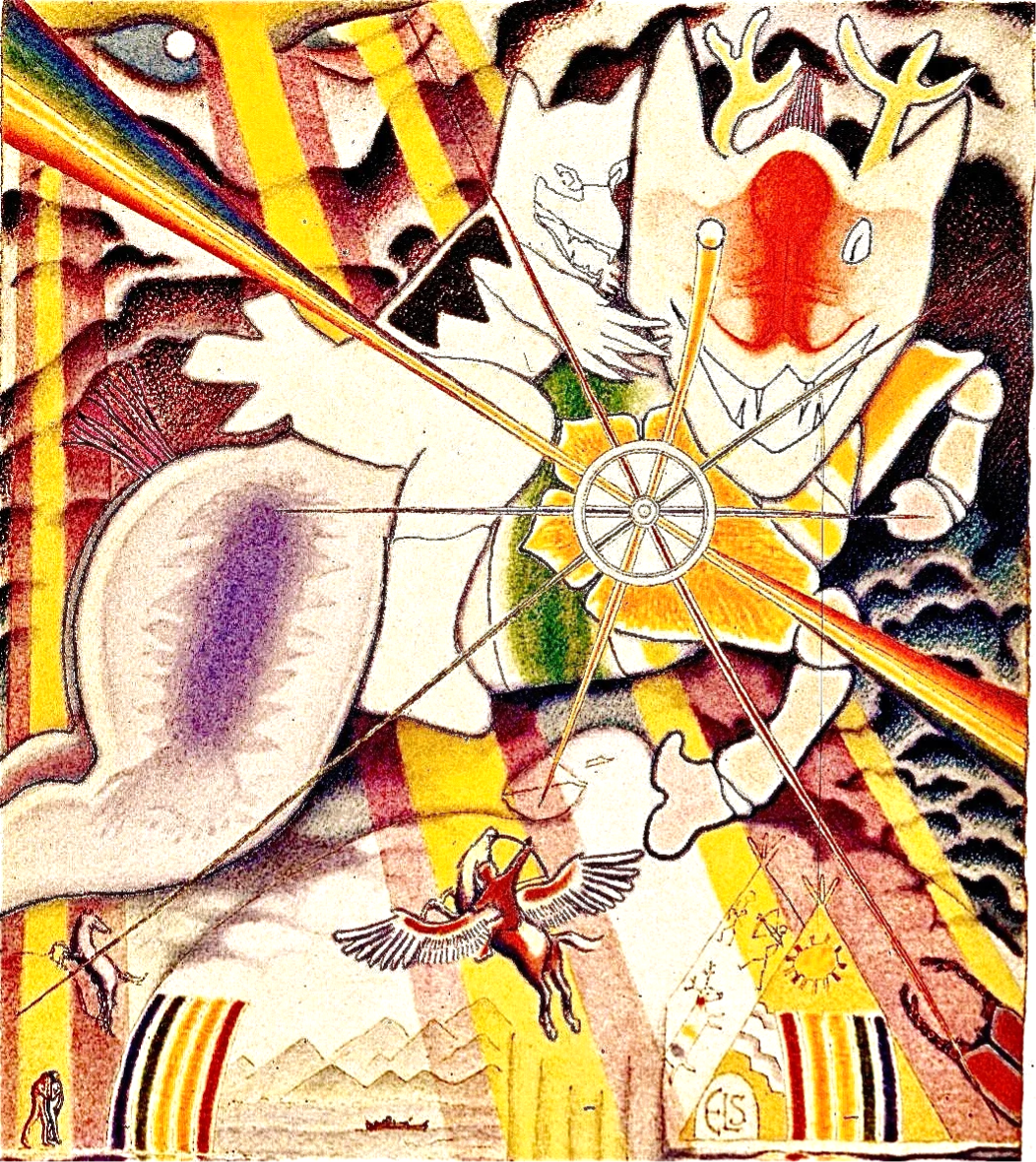
I placed the wheel — the sun — at the very heart of this composition, and it is doing more than one kind of work. It is the cosmic axis, the wheel of fate, but more intimately, it is God's heart. I chose the sun as a symbol for the divine interior — that deep, radiant connection between the sacred and the natural world — because light is the one thing that is simultaneously everywhere and sourceless to the naked eye. From this heart, rays extend outward, illuminating everything, organizing everything, judging nothing.
Adam and Eve's banishment to Cythera is the focal point of those rays. I wanted them bathed in that solar benediction not as condemned figures but as subjects caught in a light, they were never quite equipped to bear. That is the tragedy Masaccio understood so completely — not that they were evil, but that they were unprepared. My composition holds that same tenderness toward them.
The antlered figure in the upper right carries the dual burden of the sacred and the bestial — the crown of nature worn by a being that is neither fully animal nor fully divine. This is Adam as I see him: magnificent and bewildered, adorned and exposed all at once.
The large figure of a son riding the mythical divine — borne on the emanating light of that sun-heart — introduces mystery and spiritual multiplicity. I drew intentionally from images across various religious traditions, not to conflate them, but to suggest that the story of a first garden, a first knowing, a first exile, belongs to every human lineage. The tepees and mountain silhouettes in the lower register anchor this universality in Indigenous presence, grounding the mythological in the earthly.
The winged horse and archer soaring in the lower center is my Watteau breath — fête galante made mythic. Where Watteau painted elegant souls drifting through Arcadian gardens, I send mine airborne: a centaur-Pegasus hybrid, because Eden, to me, was never merely a garden. It was the original flight.
The serpentine dragon form coiling on the left, with its purple wound of a marking, embodies the seduction and the shedding — Eve's encounter rendered not as shame but as transformation. The purple bruise is the mark of consciousness, the first interior color humanity ever wore.
The rainbow ray slicing diagonally from the upper left is both divine covenant and prism — light broken into its truths. After the fall, we do not lose the light; we finally see all of its components.
The Hand Behind the Vision
This is neo-surrealism speaking in the tongue of watercolor mysticism. I chose watercolor deliberately — for its softness, its willingness to bleed and bloom, its refusal to be fully controlled. That quality mirrors the very condition of Adam and Eve: beings in a world whose rules kept shifting beneath them. The medium itself enacts the story.
And yet against that softness, I layered intricate detail — the careful rendering of the wheel's spokes, the fine stippling on the dragon form, the miniature figures at the lower margin rendered almost like manuscript illuminations. That devotion to detail was intentional. It is my declaration of dedication to this piece, to these masters, to this myth.
I employed long golden diagonal rays as both compositional anchors and symbolic force lines — the way Masaccio used perspective to draw the eye toward moral weight. Here, every ray converges on the sun-heart: all things lead back to the divine center.
The flattened, decorative color blocks in the background carry the elegance of Watteau's fêtes, while the bold saturated passages — cadmium yellows, vermillion reds, the deep cobalt shadows — remind us that even the most gilded afternoon contains darkness at its edges. I let both masters live simultaneously on the same surface without resolving their tension, because that tension is the point.
What the Canvas Asks of You
Standing before this piece, I want you to feel the vertigo of the threshold — the specific dizziness of the moment between innocence and knowledge, when both states exist simultaneously and neither can be reclaimed nor rushed toward.
This painting offers two readings, and I meant for both to be true at once: it is a meditation on humanity's relationship with the divine, and it is a map of personal growth and enlightenment. The sun-as-God's-heart does not burn Adam and Eve — it illuminates them. The banishment is real, but so is the light that follows them out.
Masaccio's expelled figures are among the most heartbreaking in all of Western art — bodies convulsed with grief. Watteau's figures float in a perpetual golden afternoon that never quite arrives or ends. I have tried to hold both feelings in one breath: the sorrow of leaving, and the impossible aliveness of the world you are falling into.
This is not a painting about punishment. It is a painting about the fullness of becoming.
The Truth I Leave With you
Every garden has a sun at its center — not to trap us, but to show us the way out and the way forward simultaneously.
We spend so much of our lives mourning the paradise behind us that we forget we are, at this very moment, the winged archer — mid-air, mid-story, carrying both the wound and the gift of knowing. Personal growth is not the absence of exile. It is learning to ride the light that emanates from the heart of whatever you hold sacred.
As Paul Klee wrote: "Art does not reproduce the visible; rather, it makes visible." This painting does not merely show you Adam and Eve. It makes visible the feeling of being human for the very first time — unprepared, luminous, and irrevocably, beautifully awake.
Add comment
Comments