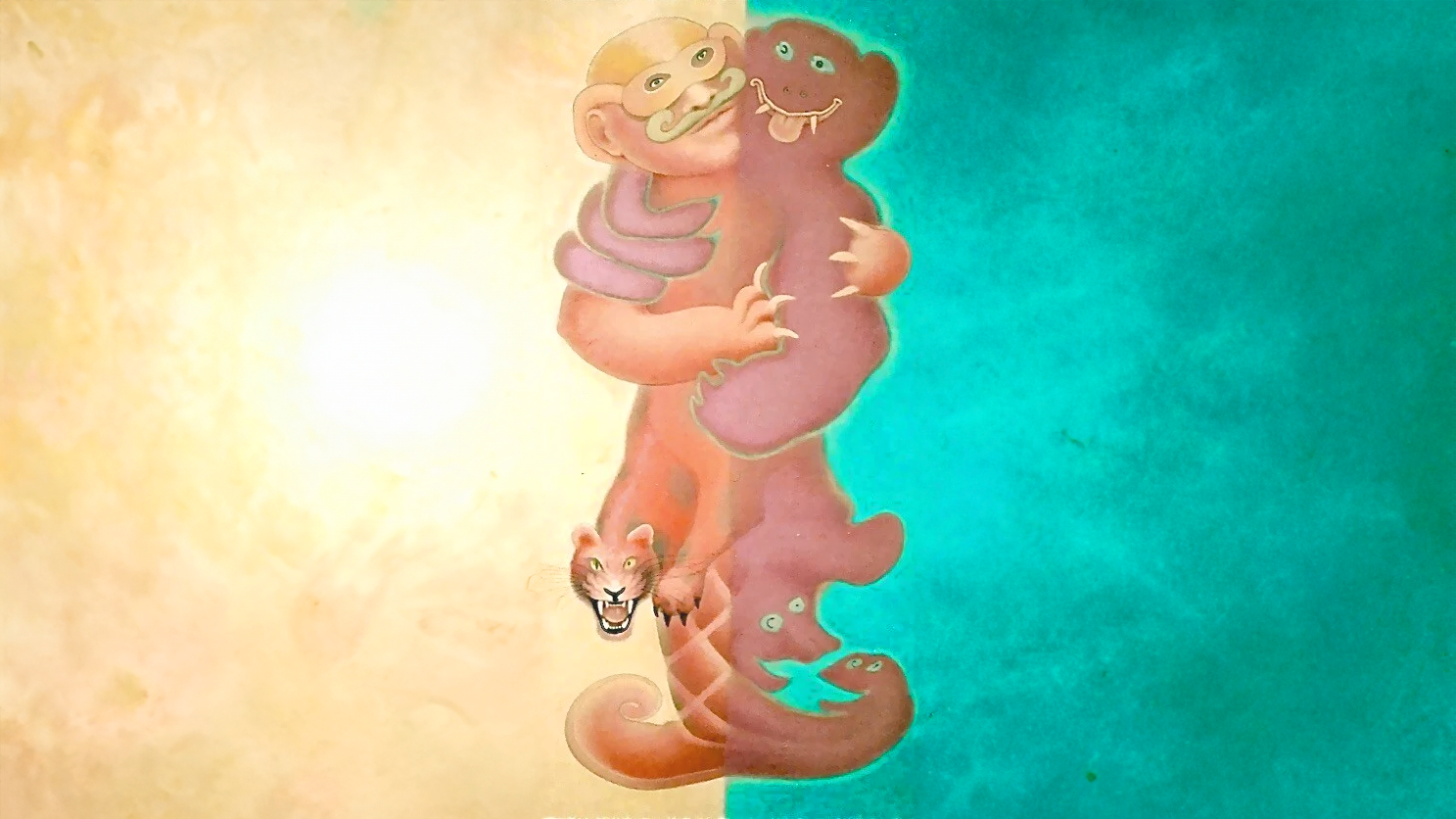
MEDIUM: Acrylic on Canvas
DATE: 1985
Twins is not just a painting—it is a mirror stretched across time. Created in 1985 and once held by my dear friend, Karate Master Linda Lutes, it has returned to me not by chance, but through legacy. In inheriting it, I inherited more than the canvas—I inherited an echo of who I was when I first brought it to life.
At its core, Twins is not about two figures, but one truth seen from opposing sides.
The bodies merge in a near-indistinguishable embrace, limbs dissolving into one another, as though identity itself is fluid. This ambiguity is intentional. Are they lovers, reflections, opposing selves? The answer shifts with the viewer.
The composition resists separation. There are no hard edges—only transitions. It challenges the illusion of individuality, suggesting that we are never as separate as we believe.
Warm tones—reds, oranges, yellows—pulse through the figures like shared blood, carrying intensity, passion, even conflict. Yet they are not chaotic; they remain contained, almost reverent. In contrast, cool blues and greens settle into the negative space, offering distance, calm, and introspection.
This duality is deliberate:
Heat without stillness becomes destruction.
Stillness without heat becomes absence.
Together, they form equilibrium.
Looking back, I see a younger artist striving for control.
The brushwork is careful, refined—almost restrained. Each stroke feels deliberate, as though I feared disrupting the harmony I was trying to create. Yet within that restraint lies sensitivity. The blending required patience—a willingness to let forms dissolve rather than assert themselves.
If I were to paint this today, I might allow more disruption, more risk. But there is honesty in this discipline—a quiet confidence that had not yet learned to be loud.
This painting lives in contradiction:
Intimate, yet unsettling.
Unified, yet ambiguous.
Tender, yet intense.
When I first created it, I believed I was painting connection—the kind we crave and fear losing. Now I see something more complex:
Dependence.
Entanglement.
The fragile boundary between unity and erasure.
The figures do not simply embrace—they risk becoming indistinguishable. And that raises the question:
At what point does connection cost us ourselves?
And still, we reach for it.
Because isolation is its own form of dissolution.
We all search for our “twin”—a counterpart who understands us without translation. But connection is never simple. It is shaped by longing, vulnerability, projection, and illusion.
What I understand now that I did not then, is this:
True connection does not dissolve identity—it refines it.
The beauty of Twins lies not in the merging, but in the tension, it holds—the delicate balance between closeness and selfhood.
Perhaps that is the real lesson:
We are not meant to lose ourselves in others,
but to discover new dimensions of ourselves through them.
— The Dichotomous Artist
Add comment
Comments